Buyers often treat everything after the coater as “the oven”. It is three separate jobs, and putting them in the wrong order — or leaving one out — produces orange peel, soft films and panels that block when stacked.
IR levelling: flow the film out
Straight off a roller coater or sprayer the film still carries the texture of how it was applied: roller marks, spray pattern, small craters. Infrared warms the coating from the surface down, viscosity drops, and the film flows level under its own surface tension before anything sets it.
An IR levelling tunnel is short, because levelling takes seconds rather than minutes. Its position is fixed: immediately after the coating station and before any curing stage. Cure first and you lock the application texture into the finish permanently.
Hot air drying: remove the solvent or water
Solvent-based and water-based coatings have to lose their carrier before the film can harden. That is evaporation, and it needs time at temperature plus moving air to carry the vapour away. A hot air drying tunnel supplies both.
This is the stage that decides your floor space. Where UV curing takes seconds, hot air drying takes minutes, so at any given line speed the tunnel has to be long enough to hold several minutes of production. Water-based coatings need more of it than solvent-based, because water evaporates more slowly. Ask for the tunnel length at your target line speed before you plan the hall — it is usually the longest single element on the line.
UV curing: harden in seconds
UV coatings do not dry. They polymerise: UV light triggers the photoinitiator and the liquid film becomes solid almost instantly. Panels come out of the oven hard enough to sand or stack straight away, which is why UV systems dominate high-volume panel finishing.
A dual-lamp UV curing oven gives two things a single lamp cannot: enough total dose for thicker films in one pass, and a fallback — if one lamp ages or fails you are not stopping the line. Because the reaction is light-driven, the practical limits are lamp power, distance to the panel and line speed. Run too fast under too little lamp power and you get a film that is hard on top and uncured underneath, which fails as soon as it is handled.
Putting them in order
- UV coating system: coat → IR levelling → UV curing. Short, fast, compact.
- Solvent or water-based system: coat → IR levelling → hot air drying → cool. Long, and the tunnel sets the footprint.
- Mixed system: UV primer stages first for speed, then a hot-air-dried top coat where the finish demands it.
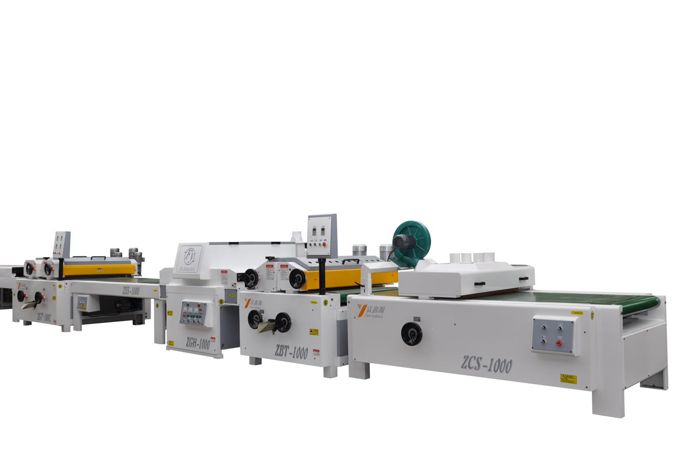
Between stages, keep the panel moving on the right conveyor: a flat belt conveyor supports thin or small parts that would sag between rollers, while a roller conveyor handles full-size panels and return runs.
What to tell us for a quotation
Coating type (UV, solvent, water-based), film thickness per coat, number of coats, panel size and the output you need per shift. Those five figures determine which tunnels you need and how long each one has to be.